
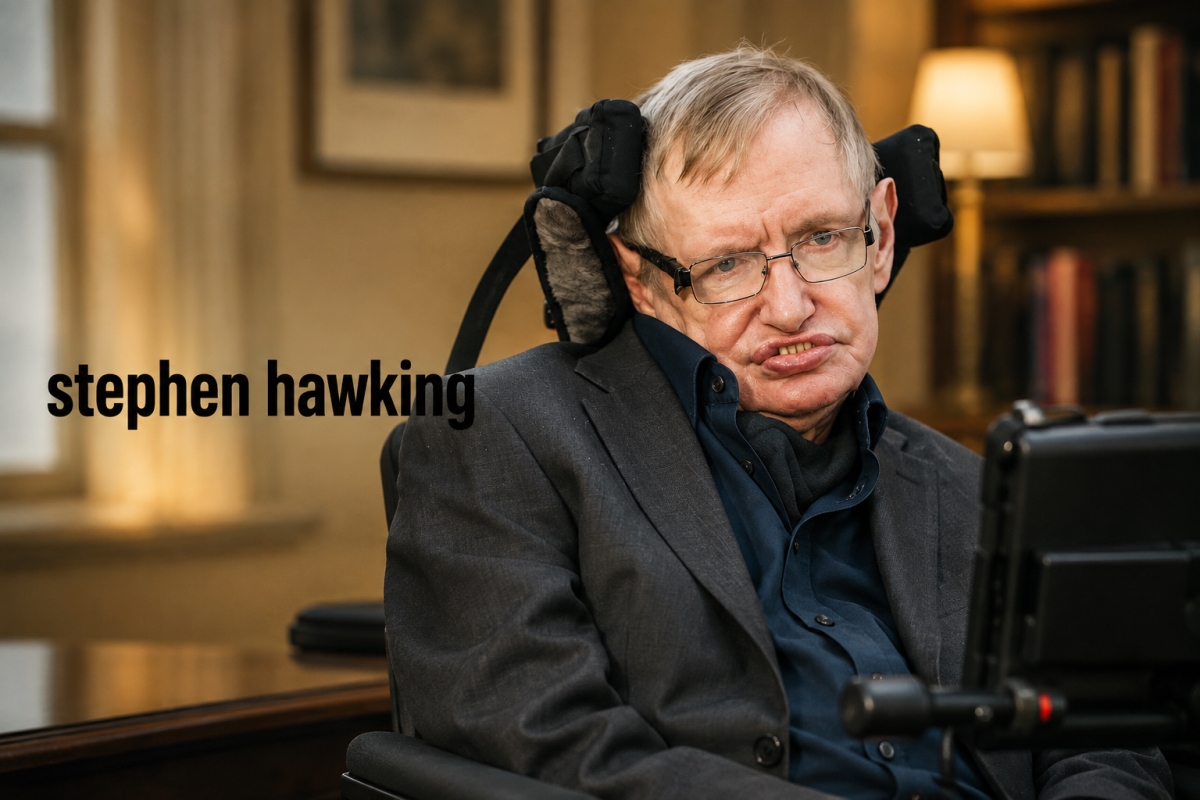
Who is Stephen Hawking?
Stephen Hawking was a world-renowned British theoretical physicist, cosmologist, and author best known for his groundbreaking work on black holes, the origins of the universe, and theoretical physics. He became one of the most influential scientists of the modern era and was famous for explaining complex scientific ideas to the general public.
Stephen Hawking was born on January 8, 1942, in Oxford. He grew up in an educated family and developed a strong interest in science and mathematics from an early age. He later studied physics at University of Oxford and earned his PhD in cosmology from University of Cambridge.
Hawking is best known for his research on black holes, including the theory of Hawking radiation, which suggested that black holes can emit radiation and eventually lose mass. His bestselling book A Brief History of Time introduced millions of people to the mysteries of the universe.
Stephen Hawking Age, Height & Weight
Stephen Hawking was born on January 8, 1942, and died on March 14, 2018, at the age of 76 years.
Stephen Hawking’s height was approximately 5 feet 7 inches (170 cm). His weight changed significantly throughout his life due to his medical condition, amyotrophic lateral sclerosis (ALS), which affected his physical abilities. His weight in adulthood was estimated to be around 60–65 kilograms (132–143 pounds), though exact figures varied over time.
Despite severe physical limitations caused by ALS, Hawking continued his groundbreaking scientific work for decades. Using assistive technology, he communicated his ideas and remained an influential figure in physics, inspiring millions through his research, books, and public appearances.
His legacy is remembered not for physical measurements, but for his extraordinary contributions to understanding black holes, cosmology, and the nature of the universe.
Stephen Hawking Net Worth (2025 & 2026)
Stephen Hawking was one of the most famous scientists of the modern era. His wealth came mainly from his academic career, bestselling books, public lectures, documentaries, and media appearances.
Because Hawking passed away in 2018, his personal net worth is not an active yearly income figure. In 2025, his estimated net worth was approximately US$20 million. This estimate includes earnings from book royalties, intellectual property, and other assets associated with his lifetime work.
In 2026, his estimated estate value remains around US$20 million, though the exact value may change depending on book sales, licensing agreements, and management of his intellectual property.
Hawking’s bestselling book A Brief History of Time became one of the most successful science books ever published, selling millions of copies worldwide. His greatest legacy, however, remains his contributions to theoretical physics, especially his research on black holes and the universe.
Stephen Hawking Early Life
Stephen Hawking was born on 8 January 1942 in Oxford, England, into an educated family. His father, Frank Hawking, was a medical researcher, and his mother, Isobel Hawking, had studied philosophy, politics, and economics at University of Oxford. The family valued learning, and Hawking grew up in an environment that encouraged curiosity and intellectual exploration.
As a child, Hawking was interested in how things worked and enjoyed building mechanical devices and solving puzzles. He attended St Albans School, where he developed a strong interest in mathematics and science. Although he was not always considered an exceptional student in the traditional sense, he showed creativity and a talent for understanding complex ideas.
In 1959, Hawking entered University of Oxford to study physics. He earned his undergraduate degree in 1962 and later moved to University of Cambridge to study cosmology (the study of the origin and development of the universe).
During his early twenties, Hawking began experiencing symptoms of a rare motor neuron disease, later diagnosed as Amyotrophic lateral sclerosis (ALS). Doctors initially gave him only a few years to live, but he continued his research and adapted to his changing physical abilities. His determination during this period shaped the rest of his remarkable scientific career.
Hawking’s early life laid the foundation for his later work on black holes, the universe, and theoretical physics, making him one of the most influential scientists of the modern era.
Stephen Hawking Biography & Personal Info
| Category | Information |
| Full Name | Stephen Hawking |
| Date of Birth | 8 January 1942 |
| Birthplace | Oxford, England |
| Birth Sign (Zodiac) | Capricorn ♑ |
| Nationality | British |
| Profession | Theoretical physicist, cosmologist, author, and professor |
| Father | Frank Hawking (medical researcher) |
| Mother | Isobel Hawking |
| Education | University of Oxford (Physics); University of Cambridge (Cosmology) |
| Major Field | Cosmology, black holes, quantum gravity, and theoretical physics |
| Famous For | Research on black holes and the theory of Hawking radiation |
| Best-Known Book | A Brief History of Time |
| Medical Condition | Diagnosed with Amyotrophic lateral sclerosis (ALS) in his early twenties |
| Marriage | Married Jane Wilde Hawking in 1965; later married Elaine Mason |
| Children | Three children: Robert, Lucy, and Timothy |
| Academic Position | Lucasian Professor of Mathematics at University of Cambridge (1979–2009) |
| Awards & Honors | Received the Copley Medal, Presidential Medal of Freedom, and many other honors |
| Date of Death | 14 March 2018 |
| Age at Death | 76 years |
| Legacy | Remembered as one of the most influential scientists of the modern era for explaining complex ideas about the universe to the public |
Stephen Hawking Career & Achievement
Stephen Hawking was a famous British theoretical physicist and cosmologist known for his groundbreaking work on black holes and the universe. He studied at Oxford and Cambridge and became the Lucasian Professor of Mathematics at Cambridge. His greatest achievement was the discovery of Hawking radiation, which showed that black holes can release energy. He also contributed to the study of singularities and the origin of the cosmos. His book A Brief History of Time introduced complex scientific ideas to millions of readers worldwide. Despite living with ALS, Hawking continued his research and inspired people through his dedication and curiosity. He received many awards and became a symbol of scientific excellence. His discoveries remain important in modern physics and astronomy today.
Stephen Hawking Awards
Stephen Hawking received many prestigious awards and honors for his contributions to physics and cosmology. Some of his notable awards include:
- Copley Medal (2006) — Awarded by the Royal Society for his outstanding contributions to theoretical physics.
- Presidential Medal of Freedom (2009) — The highest civilian honor in the United States, recognizing his achievements in science.
- Wolf Prize in Physics (1988) — Received for his important work in theoretical physics and understanding the universe.
- Albert Einstein Medal (1979) — Honored for his contributions to gravitational physics.
- Adams Prize (1966) — Awarded by the University of Cambridge for his research on singularities.
- Fundamental Physics Prize (2013) — Recognized for his discoveries about black holes and quantum effects.
Hawking also received numerous honorary degrees and international recognitions. His awards reflected his major role in advancing our understanding of black holes, space, and the origins of the universe.
Short FAQ about Stephen Hawking
Q1: Who was Stephen Hawking?
Stephen Hawking was a British theoretical physicist and cosmologist famous for his research on black holes and the universe.
Q2: When was Stephen Hawking born?
He was born on January 8, 1942, in Oxford, England.
Q3: What was Stephen Hawking famous for?
He was famous for discovering Hawking radiation and studying black holes and the origins of the universe.
Q4: What was his most popular book?
His most popular book was A Brief History of Time, which explained scientific ideas to general readers.
Q5: What disease did Stephen Hawking have?
He was diagnosed with amyotrophic lateral sclerosis (ALS) at the age of 21.
Q6: What awards did Stephen Hawking receive?
He received many honors, including the Copley Medal and the Presidential Medal of Freedom.
Q7: When did Stephen Hawking die?
He died on March 14, 2018, at the age of 76.
